
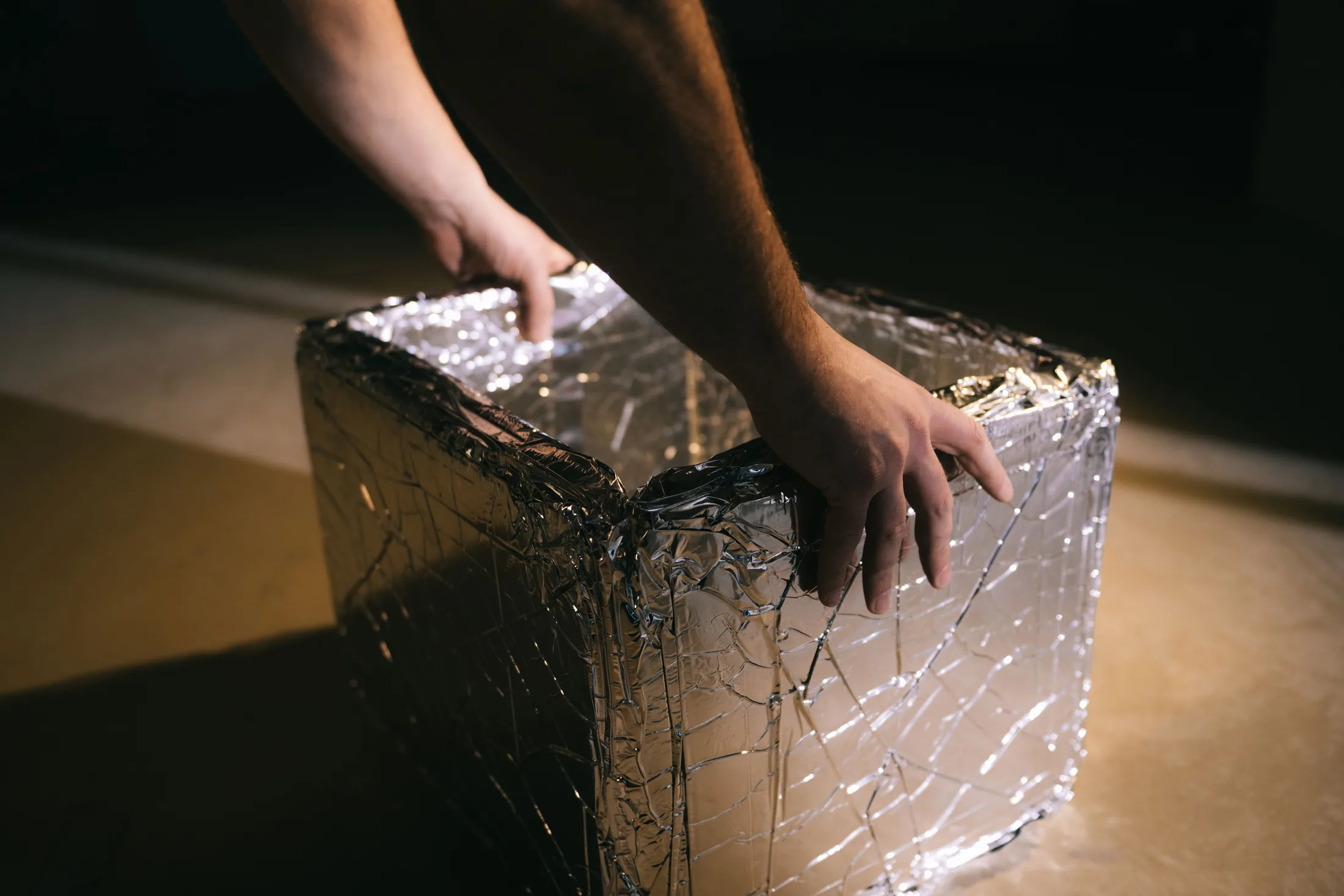
This article explains where vacuum insulation outperforms conventional materials, where it doesn't, and how that difference pays off in the final product.
The short answer
Vacuum insulation provides many times the thermal performance of conventional materials at the same thickness. The decisive advantage is therefore not the insulation itself, but what it achieves within the product. It creates more usable volume, better energy efficiency ratings, and greater design freedom. With perlite vacuum insulation, the vacuum panel is also inherently stable, combining structure and insulation into a single component.
Key takeaways
- In conventional insulation, heat is primarily transferred via gas molecules. Vacuum insulation eliminates this specific mechanism.
- The value is rarely in the insulation itself, but in the product around it: more usable volume, a more compact design, and the elimination of unnecessary structural elements.
- Rising ecodesign requirements and regulatory pressure on PU foam are making this a necessity rather than an option for many product categories.
- Comparing only material costs per square meter overlooks the bigger picture of the actual benefits.
- Vacuum insulation isn't for every application. Below certain thicknesses and without space constraints, conventional insulation remains the right choice.
The question of the benefits of vacuum insulation is usually framed too narrowly. Simply comparing technical data sheets reveals a clear winner, but provides no reliable basis for a decision. The real difference only becomes apparent when you look at the product in which the insulation is installed.
Why does vacuum insulate better?
Because the most important heat transfer mechanism is simply removed. In conventional insulation, heat is primarily transported by gas molecules within the pores. Materials like polystyrene, mineral wool, and PU foam mainly reduce air movement (convection), but heat conduction through the gas itself remains the dominant factor. Vacuum insulation addresses this directly. A porous core material is enclosed in a gas-tight high-barrier film and evacuated. Once the gas molecules are largely removed, the primary source of heat transfer disappears. What remains is solid-state conduction and radiation, both of which are significantly lower.
The core material must withstand the atmospheric pressure created by the vacuum while maintaining a porous structure that allows the vacuum to exist. Atmospheric pressure is substantial—about 10 tons per square meter—which is why vacuum insulation has a higher density than conventional insulation. The quality of the result depends on a detail we will return to later: the pore size of the core material determines how high the vacuum needs to be and how stable the performance remains over the years.
A direct comparison of core materials shows the scale of the difference. These values refer to the core material itself, not the finished system assembly, which may vary depending on the design.
Natürliches Material, geringer Energieaufwand
Natürliches Material, geringer Energieaufwand
Problemat. Schäumgase,
geringe Rezyklierbarkeit
Natürliches Material, geringer Energieaufwand
Sehr hoher Energiebedarf bei der Herstellung
Natürliches Material, geringer Energieaufwand
λ = thermal conductivity of the core material. U-value calculated for 50 mm thickness using the most favorable value in the given range; for fumed silica, calculated as a 15 mm panel within 35 mm of foam. Cost per insulation performance is an index of the core material costs required to achieve a specific level of thermal performance. EPS is normalized to 1.0; lower values are better. The index compares performance, not area or thickness. Source: internal calculations.
Two things stand out in this table. First, evacuated perlite achieves roughly three times the thermal performance of PUR foam and about five times that of conventional insulation. Second, perlite is the only core material in this overview that is simultaneously high-performing, economical, and sustainable. While fumed silica achieves a lower thermal conductivity value, it comes at the cost of significantly higher prices and an energy-intensive manufacturing process.
Sustainability is assessed using transparent criteria. PUR foam is burdened by blowing agents and low recyclability, while fumed silica requires a very high energy input during production. Perlite is a natural mineral material that requires minimal energy for processing.

With evacuated perlite, there is no gas content at all. Sources: Wutz Handbook of Vacuum Technology (Vieweg+Teubner Verlag), internal measurements.
What specific advantage does this offer in a product?
The advantage is almost never in the insulation itself, but in what it achieves within the product. The higher insulation performance can be used in two fundamentally different ways, and the decision on this should be made at the very beginning of any design process.
First, identical external dimensions with thinner insulation. The space gained becomes usable volume. For a refrigerator, this means more storage space with the same footprint; for a storage tank, it means more capacity within the same installation area.
Second, the same insulation thickness with lower heat loss. Energy consumption decreases, and the energy efficiency class improves. In product categories with energy labels, this is directly relevant to sales.
The most interesting case, however, is a third one, which is regularly overlooked. When the wall thickness changes, the installation space changes. And when the installation space changes, the product can be designed differently. In one of our projects, a freezer was not just re-insulated, but re-imagined. The improved insulation allowed for a different arrangement of the cooling technology, designed as an easily replaceable drawer. Usable volume, serviceability, and energy efficiency all improved simultaneously.
There is also a point specific to perlite vacuum insulation: the vacuum body is inherently stable. It provides structural support instead of requiring it. This allows for the elimination of structural elements, such as spacers or parts of the support frame. One component replaces two functions.
What are the regulatory drivers behind this decision?
Two developments that are independently pointing in the same direction.
The first concerns energy efficiency. EU ecodesign regulations for products are continuously being revised, and thresholds are becoming stricter. For hot water tanks, for example, the maximum permissible heat loss for the top label is dropping significantly. For manufacturers, this means that insulation that is sufficient today may cost them a label tomorrow.
The second concerns the material itself. PFAS-free blowing agents, halogen-free flame retardants, fewer crude oil-based raw materials, and closed material cycles. All of this puts pressure on foamed insulation materials from several directions at once. Perlite is a volcanic rock and is unaffected by these stricter requirements.
For preliminary development, this means the question is less about whether a higher-performance insulation technology is needed, but rather when your own product line will reach the point where conventional insulation no longer meets the requirements.
How does vacuum insulation perform over its service life?
This is almost always the second question that comes up in customer meetings, and it is a valid one. A vacuum that absorbs gas over the years loses its insulating performance. Therefore, the decisive factor is not the initial value, but the long-term trend.
The interplay between the pore size of the core material and the vacuum tightness of the envelope is critical to the service life of vacuum insulation. Over the years, a small but measurable amount of gas enters the vacuum space through diffusion processes. This amount must be known when designing an insulation product in order to assess the increase in thermal conductivity.
Perlite offers a decisive advantage when it comes to aging processes. Due to the high mechanical rigidity of the core material, there is no shrinkage in thickness, which can degrade initial insulation values, particularly in vacuum insulation based on fumed silica. We have measured freezer doors with different insulation technologies over several years. The perlite vacuum insulation showed by far the lowest increase in thermal conductivity.
For design purposes, this means you can calculate with a final value that is close to the initial value. Anyone who has to plan for a generous safety margin instead ends up wasting the very space that the technology is intended to save.
Why does pore size determine insulation performance?
When comparing different core materials, the pore size in the support structure is a decisive factor, as it determines how good the vacuum needs to be to achieve effective insulation. To understand this, one must look at the heat transfer mechanism at a microscopic level. Gas molecules transport heat like a chain. Each molecule absorbs energy from a warmer neighbor upon collision and passes it on to a colder one, much like billiard balls transferring an impact. Heat travels through the pore via many such collisions.
If the gas pressure is lowered to the point where a molecule crosses the pore without encountering another, this chain is broken. The molecule then only oscillates between two wall points, carrying very little heat forward. This is precisely the point at which thermal conductivity drops significantly. The finer the pores, the sooner this point is reached and the less deep the vacuum needs to be. These relationships have been known for over 100 years and can be found in literature under the names Knudsen effect or Smoluchowski effect.
The impact of the Knudsen effect can be seen in the following diagram, where thermal conductivity is plotted against gas pressure. The gas pressure scale is in the range of around 1 mbar, which is one-thousandth of atmospheric pressure.

The finer the pore structure, the flatter the increase as gas pressure rises. Schematic representation. Sources: Wutz Handbook of Vacuum Technology (Vieweg+Teubner Verlag), internal measurements.
The comparison shows why a low initial value alone tells only part of the story. Glass fiber achieves the best value in a near-perfect vacuum, but loses this lead as soon as the pressure rises slightly, performing worse than perlite above approximately one millibar. Silica remains flat across the entire range and is therefore the least sensitive, but this comes at the cost of higher prices and primary energy consumption. Perlite combines a robust performance curve with a cost level that is industrially viable.
In detail, this becomes more complex due to different types of gases, mainly nitrogen, oxygen, and water vapor. Added to this are sorption effects for the various gas types, which lead to parts of the gas volume being bound within the vacuum space. Consequently, stable performance is not a material property alone, but a matter of process quality. High-barrier film, internal sorption material, and specialized leak-testing measurement technology are inseparable components. This is precisely why we view vacuum insulation as a system rather than just a material.
Why perlite and not fumed silica?
Because the question can only be answered meaningfully within the context of the system. Fumed silica, as used in classic vacuum insulation panels, achieves very good values on the level of pure technical specifications. However, anyone who makes a decision based solely on those figures misses three dimensions that often carry more weight in industrial applications.
Material costs. Perlite is a naturally occurring volcanic rock, whereas fumed silica is a complex, manufactured industrial product. The difference in material price is significant and, in many applications, determines whether a product remains cost-effective.
Primary energy. The production of fumed silica is energy-intensive. Perlite is mined, expanded, and ground. When looking at the insulation value per unit of primary energy used, the picture is significantly different than a simple lambda comparison suggests.
Design. Vacuum insulation panels are installed as finished boards or foamed in place, creating thermal bridges at every joint. In contrast, the perlite vacuum body is built in the shape of the product, even in three dimensions. As a result, the system value of an assembly can differ significantly from the core material's rating, in either direction.
To be honest, both apply. If you are looking exclusively for the lowest core value, you won't find it with perlite. If you are looking for an industrially scalable, economically viable, and regulatorily robust system, you certainly will.
Does it pay off?
More often than the initial calculation might suggest. The decisive factor is which alternative you are comparing it against, as the two most obvious comparisons lead to completely different results.
Compared to classic vacuum insulation panels based on fumed silica, the comparison clearly favors perlite. The core material is many times cheaper because it is a naturally occurring rock rather than a complex, manufactured industrial product. Anyone using silica panels today, or citing their price as an argument against vacuum insulation, is calculating based on the most expensive option available.
Compared to PU foam, the calculation is more nuanced, and we are open about the outcome. In some applications, production costs are slightly higher than those of a foam solution. This is offset by significantly higher insulation performance, which translates directly into energy consumption, efficiency ratings, and usable volume. In other applications, especially with large insulation volumes, production costs are actually lower because the need for foam and associated structural elements is eliminated.
The common mistake is to compare material costs per square meter. A comprehensive view must include several items that do not appear in that line item: structural elements that are no longer needed because the vacuum body is self-supporting; production process steps that are eliminated; reduced material usage elsewhere due to more compact designs; and a better energy label, for which there is often a willingness to pay a premium in the market.
Whether the numbers add up in a specific case depends on the quantity, geometry, and product category. There is no one-size-fits-all answer, but we can calculate it early and reliably. That is exactly what we do together with the client in the first project phase.
When is vacuum insulation not worth it?
Vacuum insulation requires a minimum thickness to leverage its advantages. For STRATMO, this range is around 30 mm; for STRATMO+, it is around 10 mm. Below these thresholds, the effort is rarely justified by the benefits, with rare exceptions in individual cases.
It is also of little value where installation space is not a constraint and there are no efficiency requirements. If a wall can be as thick as needed and no one is asking for an energy label, conventional insulation is the right choice. We will tell you if that is the case.
It also requires an assessment of your own production processes. A vacuum body is not created on a foam line. We describe how to resolve this point without it becoming a project bottleneck in our article on collaboration.
How to evaluate its use in your product
- Define the objective. First, decide whether you want to convert the gained space into usable volume, a better efficiency class, or a more compact design. This decision shapes the entire layout.
- Set a broad system boundary. Do not just look at the insulation layer; consider the component along with all adjacent functions. Only then will you see which construction elements and process steps can be eliminated.
- Determine the regulatory timeline. Check when your product category will be affected by the next Ecodesign revision. This will define your development window.
- Calculate total costs, not just material costs. Base your calculation on the product level, including manufacturing, design, and market price sensitivity.
- Start with a pilot product. Choose a specific product rather than making a fundamental decision. This keeps resource requirements manageable.
Frequently asked questions
Is vacuum insulation the same as a vacuum insulation panel?
No. A vacuum insulation panel is a finished board that is inserted or foamed into place, often resulting in thermal bridges at the joints. Perlite vacuum insulation, by contrast, forms a continuous, self-supporting vacuum body in the shape of the product. Both use the same physical principle, but result in very different components.
Does vacuum insulation replace PU foam one-to-one?
Technically possible, but usually not economically viable. Simply swapping the insulation layer wastes most of the potential benefits, as the real advantages come from changing the product architecture. The better approach is to rethink the product starting from the space gained.
What happens if the vacuum is breached?
The affected vacuum panel loses its vacuum effect and then provides insulation roughly equivalent to a conventional insulating material. The component does not fail completely, but its performance drops significantly. Protective structural layers, handling protocols, and quality assurance during production are specifically designed to address this risk.
Is vacuum insulation suitable for high temperatures?
The operating range depends on the combination of materials, particularly the foil and the seals. Perlite itself is a mineral and is temperature-resistant. We determine the specific limits on a case-by-case basis, as they depend on the overall design.
Conclusion
The advantages of vacuum insulation cannot be captured in a single data point. Physically, it is about eliminating the dominant mechanism of heat transfer. In terms of the product, it is about something else entirely: space, efficiency classes, eliminating unnecessary components, and the question of whether a product line can still meet future requirements.
Once you adopt this perspective, you quickly realize that the interesting question is not which insulation material has the lowest thermal conductivity. It is what kind of product you can create when insulation is no longer a limiting factor. Vacuum insulation. Rethought. Mass-produced.
If you would like to explore what this means for your product, please get in touch. In an initial technical consultation, we can work together to identify where the greatest potential lies for your application. You can reach us at info@terravac.eu.
Detailed answers to further questions can be found in our FAQ.