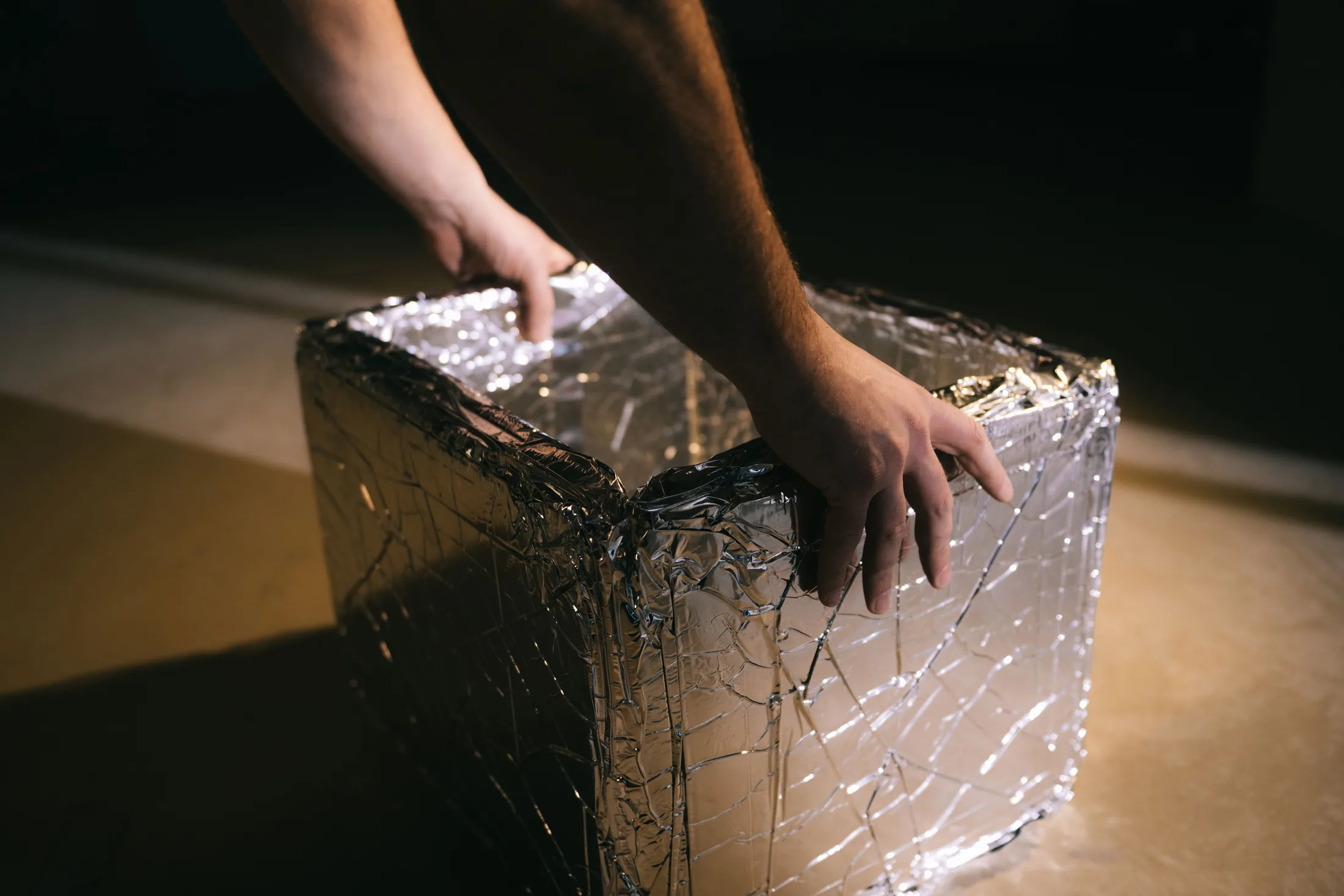

This article explains the structure, material, and manufacturing of vacuum insulation made from perlite and high-barrier film, and shows what this means for your product.
In brief
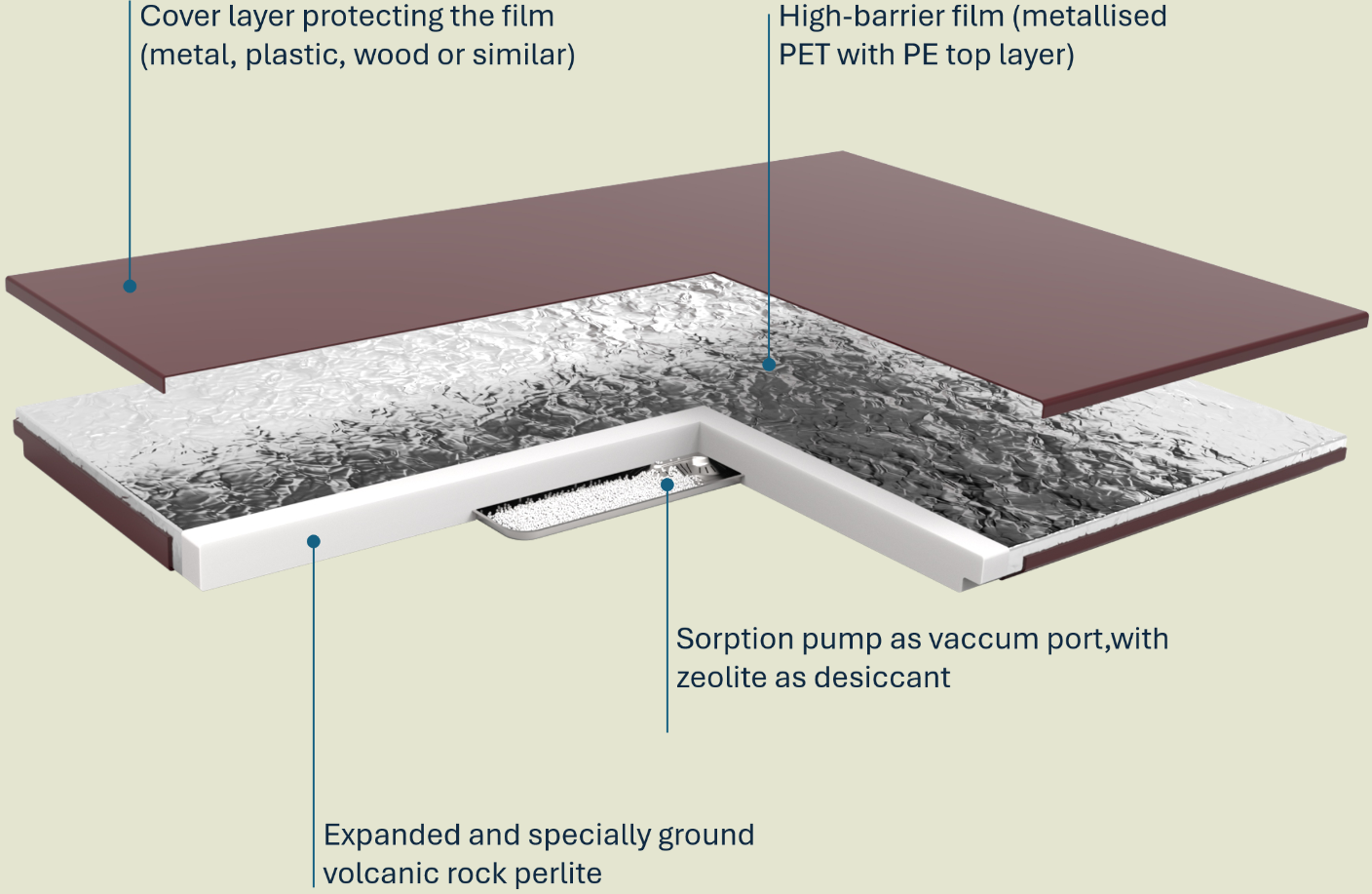
Film-based perlite vacuum insulation consists of three elements. A core of expanded and milled perlite, a volcanic mineral, is filled into a gas-tight high-barrier film and evacuated. Because there are hardly any gas molecules left in a vacuum to transport heat, the body insulates many times better than conventional insulation materials. The external air pressure compresses the loose fill into a solid, self-supporting component that can also be manufactured in three-dimensional shapes to suit your product.
The essentials
- Perlite vacuum insulation is a system consisting of a core material, an envelope, and a vacuum. None of these three elements works on its own.
- Perlite is a naturally occurring volcanic rock. It is first expanded and then milled. Milling creates sharp-edged fragments with tiny pores, which is exactly what a good vacuum core requires.
- The high-barrier film replaces the steel casing that has enclosed evacuated perlite in cryogenics for decades. This is what makes the technology lightweight, formable, and suitable for mass production.
- Air pressure turns a loose fill into a load-bearing component. Insulation and structure are created in a single step.
- The application range is generally limited not by the perlite, but by the envelope.
If you are in the preliminary development stage and need more usable volume, a better energy efficiency class, or a slimmer design, you will hit a physical limit with conventional insulation. You can always add more thickness, but making it thinner is rarely an option. Film-based perlite vacuum insulation shifts this boundary. In this article, we explain how it is constructed and why every element has its place.
What is film-based perlite vacuum insulation?
It is vacuum insulation with a core made of expanded and milled perlite, with the vacuum maintained by a high-barrier film. Three elements work together here: the perlite core forms a porous, pressure-resistant support structure; the film encloses this core in a gas-tight manner; and the vacuum inside removes the primary pathway for heat transport.
Compared to foam, this structure provides significantly better insulation at the same thickness. It differs from classic vacuum insulation panels primarily in its form. Instead of pre-made boards, it creates a self-supporting body in the geometry of the product, even in three dimensions.
Each of the three elements has a clear task, and none works without the others. This is precisely why we view vacuum insulation as a system rather than just a material.
Why does an evacuated body insulate so well?
Because the most important path for heat is eliminated in a vacuum. In conventional insulation, heat travels primarily via gas molecules in the pores. Each molecule transfers energy to its neighbour upon collision. Through many such collisions, heat travels from the warm side to the cold side.
At normal atmospheric pressure, an air molecule travels an average of only about 70 nanometres between two collisions. If the pressure is reduced, this distance increases in the same proportion. If it becomes larger than the pores of the core material, the molecule almost exclusively hits pore walls instead of other molecules. The chain is broken, and heat conduction via the gas collapses. In physics, this is known as the Knudsen effect.
What remains are two minor components: heat conduction via the contact points of the solid material and thermal radiation. A good core material keeps both to a minimum. It only touches at a few points and scatters radiation through its fine structure.
For your product, this means that the same insulation effect can be achieved with a fraction of the wall thickness. We show how pore size and vacuum quality are related in detail in our article on the benefits of vacuum insulation.
Why is perlite the core material?
Because expanded and milled perlite combines three properties required for a vacuum core, while being available in industrial quantities. It is fine-pored, pressure-resistant and pourable.
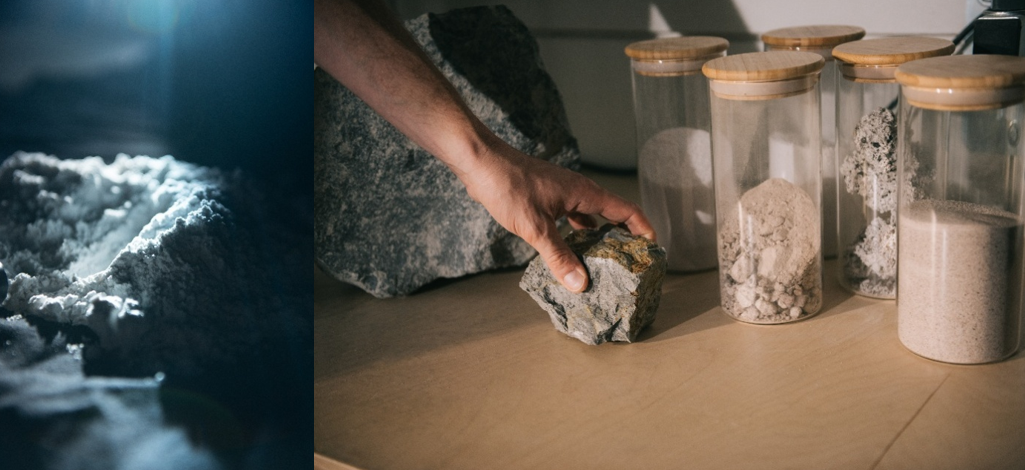
Perlite is a naturally occurring volcanic glass containing around two to five per cent chemically bound water. When the milled rock is suddenly heated to over 750 degrees Celsius, this water evaporates and expands the softened grains, much like popcorn. In the process, the rock expands to about 20 times its original volume.
For vacuum insulation, this is only half the journey. Expanded perlite consists of relatively large, hollow grains. It is only the subsequent milling that breaks them into sharp-edged fragments with minimal contact points, between which small pores are formed. This fineness is crucial, because the smaller the pores, the sooner the Knudsen effect sets in and the less deep the vacuum needs to be.
This processing provides the benefits. The fine-pored structure allows the vacuum to take effect even at moderate negative pressure. The pressure stability allows the core to withstand atmospheric pressure without collapsing. The pourability ensures that the material fills every casing, even in complex shapes. And as a mineral material, perlite is free from blowing agents and flame retardants, which are coming under increasing regulatory pressure in foamed insulation materials.
A simple comparison shows just how much of a difference the vacuum makes. As a loose fill at normal atmospheric pressure, expanded perlite is a solid but unspectacular insulation material; in construction, its thermal conductivity is around 45 to 65 mW/m·K. Once evacuated, the same material as the core of our STRATMO reaches around 7 mW/m·K. The difference lies not in the rock, but in the vacuum.
We have explained in detail why we do not rely on fumed silica, as used in classic vacuum insulation panels, in our article on the advantages . In short, it is not the lowest core value that is the deciding factor in industrial applications. The decisive factor is the interplay between insulation performance in the system, material costs, primary energy and design.
What does film-based mean?
Film-based means that a thin high-barrier foil holds the vacuum, rather than a rigid container. That might sound like a detail. It is the reason why the technology fits into mass-produced products and not just large-scale systems.
Evacuated perlite has been proven in cryogenics for decades. Large tanks for cryogenic liquefied gases are built with double steel walls, with the space between them filled with perlite and evacuated. This works reliably, but it is heavy, complex and limited to simple geometries. This approach is not suitable for a cooling appliance, a storage unit or a transport box.
The high-barrier foil solves this problem. It is lightweight, adapts to the shape and can be processed in industrial quantities. Its task is all the more demanding. It must keep air and water vapour out as much as possible throughout the entire product life cycle, because every molecule that penetrates contributes to heat transfer again.
Inside, sorption material binds the small amounts of water vapour that do penetrate. On the outside, cover layers protect the foil from mechanical stress during assembly and operation. It is the interplay of the core, foil, sorption material and cover layers that determines performance in the product. We cover how we ensure this interplay over the product's service life in a separate article.
For you, this means design freedom. The insulation follows the geometry of your product, not the other way around.
Why is the vacuum body inherently stable?
Because atmospheric pressure holds it together. As soon as the casing is evacuated, the atmosphere presses against the foil from the outside with a force of around ten tonnes per square metre. This compresses the perlite fill firmly, causing the sharp-edged fragments to interlock. A loose granulate becomes a rigid, load-bearing body.
This is what distinguishes film-based perlite vacuum insulation from classic vacuum insulation panels. The latter are finished boards that are inserted or foamed into place. The surrounding foam then provides stability and fills the gaps. The perlite vacuum body, on the other hand, is self-supporting.
Because the loose fill conforms to any shape before it is compressed, the body can also be constructed in three dimensions. Corners, edges and curved surfaces are created without joints between individual panels.
For design purposes, this means that a single component performs two functions: insulation and structure. Spacers or parts of the support structure can be eliminated, along with
process steps in your production.
A freezer from one of our projects shows just how far this can go. Instead of replacing the foam one-to-one, the appliance was rethought. The wall thickness gained allowed for a different arrangement of the cooling technology, designed as an easily replaceable drawer. The result was a different product, not just one that was better insulated.
How is a perlite vacuum body created?
In five steps that sound simple but require high process discipline in series production.
- Prepare the envelope. The high-barrier foil is cut to size and formed into an envelope matching the geometry of the final component.
- Fill. The expanded and ground perlite is filled into the envelope and distributed evenly so that the insulation effect and stability are consistent throughout.
- Evacuate. The air is extracted. Atmospheric pressure compresses the fill, and the body becomes rigid.
- Seal. The envelope is sealed to be gas-tight. From this point on, the foil maintains the vacuum.
- Test. Our measuring technology checks for airtightness and insulation performance before a component leaves the factory.
Depending on the application, cover layers or embedded components are added. The performance of a vacuum body is therefore not just a material property, but the result of a mastered process.
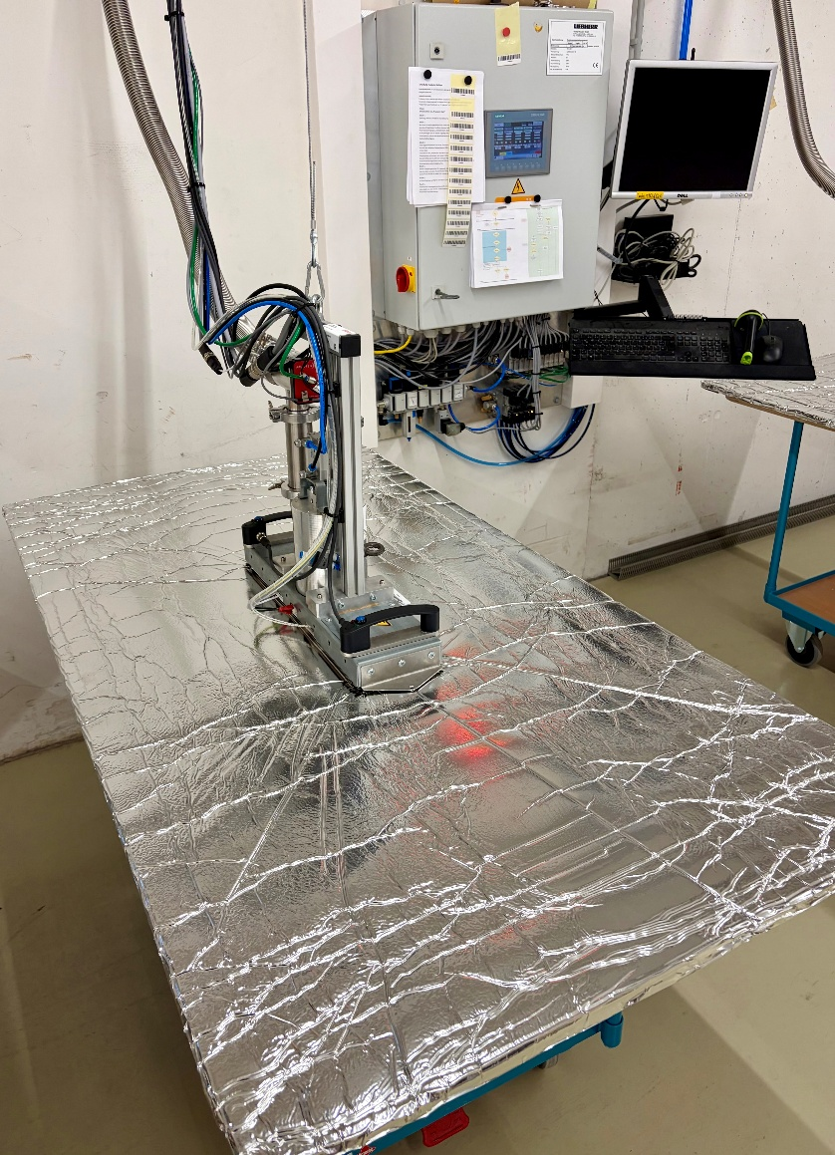
This is precisely where the industry's hurdle has been for decades. Three-dimensional vacuum insulation made from perlite fill in foil was physically understood, but not ready for series production. TerraVac emerged from the Liebherr Group to take this step and has been an independent company since December 2023. Our own laboratories, thermal measuring technology and production are all under one roof in Karlstadt.
For you, this means that initial prototypes are created in months rather than years. And that we can manufacture components ourselves before your own production line is ready.
For which temperatures and applications is the technology suitable?
For a very wide range, although the limit is usually set by the envelope rather than the perlite. As a mineral rock, perlite remains stable from cryogenic to high temperatures. The foil has narrower limits.
STRATMO is designed for operating temperatures from minus 270 to plus 150 degrees Celsius. With a pure foil envelope, the upper limit is plus 50 degrees Celsius. We determine the specific design on an application-by-application basis, as it depends on the temperature profile and mechanical load.
Three product lines are based on this principle. STRATMO is the self-supporting, series-proven perlite vacuum body for most applications. STRATMO+ additionally embeds a glass fibre panel and is intended for the highest insulation requirements or low weight. SILYNT combines vacuum insulation with thermoelectric cooling for cooling appliances with minimal installation space, such as cooling drawers.
Typical areas of application include refrigerators and freezers, pharmaceutical and transport boxes, hot water and heat pump storage tanks, district heating pipes, as well as panels and boards. What they all have in common is a bottleneck in terms of installation space, energy efficiency, or weight.
Where does the technology reach its limits?
Where installation space is not an issue, and below a minimum insulation thickness. For STRATMO, this is around 30 millimetres; for STRATMO+, it is around 10 millimetres. Below these levels, the benefits rarely justify the effort.
Furthermore, a vacuum body is a component that requires careful handling. If the casing is damaged, the affected body will vent and then provide insulation roughly on par with a conventional insulating material. Cover layers, handling concepts, and quality assurance are specifically designed to address this risk. We cover how robust the system is in the field in a separate article.
And a vacuum body cannot be produced on a foam line. That does not have to be an obstacle. During the launch phase, we manufacture the components ourselves so that you can go into series production before you adapt your own manufacturing processes.
How to check if the technology is right for your product
- Identify the bottleneck. Clarify whether installation space, energy efficiency class, or weight is your actual bottleneck. This determines which product line is the right fit.
- Sketch the geometry. Check where a three-dimensional vacuum body could replace joints, spacers, or support structures in your product.
- Record the temperature profile. Note the minimum and maximum operating temperatures as well as the mechanical loads during assembly and operation.
- Check insulation thickness. If your current insulation is significantly above the minimum thickness, the potential for improvement is usually substantial.
- Start with a pilot product. Focusing on a specific component rather than a fundamental decision keeps the effort manageable. In the Proof phase , initial functional prototypes are created within a few months.
Frequently asked questions
Why does TerraVac use perlite as a core material?
Expanded and milled perlite is fine-pored, pressure-resistant and pourable. This allows it to support atmospheric pressure, enable the vacuum to work, and fill any shape. As a naturally occurring mineral rock, it is also free from blowing agents and flame retardants, and is economically available in industrial quantities.
For which temperature ranges is perlite vacuum insulation suitable?
Perlite itself is stable over a very wide temperature range; the limit is usually set by the casing. STRATMO is designed for minus 270 to plus 150 degrees Celsius, or up to plus 50 degrees Celsius with a pure foil casing. We determine the specific configuration based on the application.
Can perlite vacuum insulation be manufactured in any shape?
The perlite fill fills the casing before it is compressed under vacuum. This allows for three-dimensional geometries with corners and curves, without joints between individual panels. We will clarify which shape can be manufactured economically during the specific project.
Why does vacuum insulation require a high-barrier foil?
Because the insulation effect depends on the vacuum, and every gas molecule that enters transports heat. The high-barrier foil largely keeps out air and water vapour, while sorption material inside binds the rest. Unlike a steel shell, it is lightweight and malleable, which is what makes the technology viable for mass-produced products.
What is the difference between STRATMO and STRATMO+?
Both are based on a self-supporting perlite vacuum body. STRATMO+ additionally embeds a glass fibre panel and is intended for applications with the highest insulation requirements or where low weight is essential. STRATMO is the tried-and-tested base for most applications.
Conclusion
Film-based perlite vacuum insulation is, at its core, a simple idea. A mineral granulate, a sealed casing, a vacuum. The real achievement lies in bringing these three elements together to create a load-bearing, malleable, and mass-producible component.
Once you have understood the principle, the next question usually comes naturally. It is no longer about how good the insulation is. It is about what becomes possible for your product when the insulation provides structure and takes up almost no space. Vacuum insulation. Rethought. Brought to series production.
If you would like to check whether this technology is suitable for your product, get in touch with usIn an initial technical consultation, we will work together to clarify the geometry, temperature profile and the most significant factors for your application. You are also welcome to visit us in Karlstadt, where you can handle a vacuum panel yourself and see our production facilities. You can reach us at info@terravac.de.
You can find quick answers to further questions in our FAQ on technology and long-term performance.