
This article explains why wall thickness determines usable volume and energy efficiency class, how vacuum insulation changes the equation, and how to assess the potential for your own product.
In brief
When external dimensions are fixed, wall thickness becomes a decisive design variable. Every millimetre counts twice because each dimension has two opposing walls. Vacuum insulation can achieve the same thermal performance with a fraction of the thickness. The space freed up can be used to increase usable volume, improve the energy efficiency class or reduce external dimensions. Because a perlite-based vacuum insulation component can be manufactured in the three-dimensional shape of the product while also providing structural support, joints, spacers and manufacturing steps can often be eliminated. The greatest potential lies in applications where external dimensions cannot be changed.
Key takeaways
- With fixed external dimensions, wall thickness counts twice. Reducing insulation thickness by 10 millimetres on each side increases the internal dimension by 20 millimetres along that axis.
- The effect on volume is multiplicative because it applies to width, height and depth at the same time.
- Vacuum insulation turns wall thickness from a fixed constraint into a design choice. You can balance additional usable volume, a better energy efficiency class and a slimmer product design.
- The greatest benefit comes not from replacing one insulation material with another, but from redesigning the product around a thinner wall.
- Below a certain minimum insulation thickness, the benefits rarely justify the effort. For STRATMO, this is approximately 30 millimetres; for STRATMO+, approximately 10 millimetres.
In many products, external dimensions are non-negotiable. A built-in appliance must fit a 60-centimetre-wide recess, a heating system must pass through a cellar doorway, or a pipeline must follow an approved route. At the same time, manufacturers want to fit more inside and improve energy efficiency. With conventional insulation, these goals are difficult to achieve simultaneously because both depend on wall thickness.
Why does wall thickness determine usable volume?
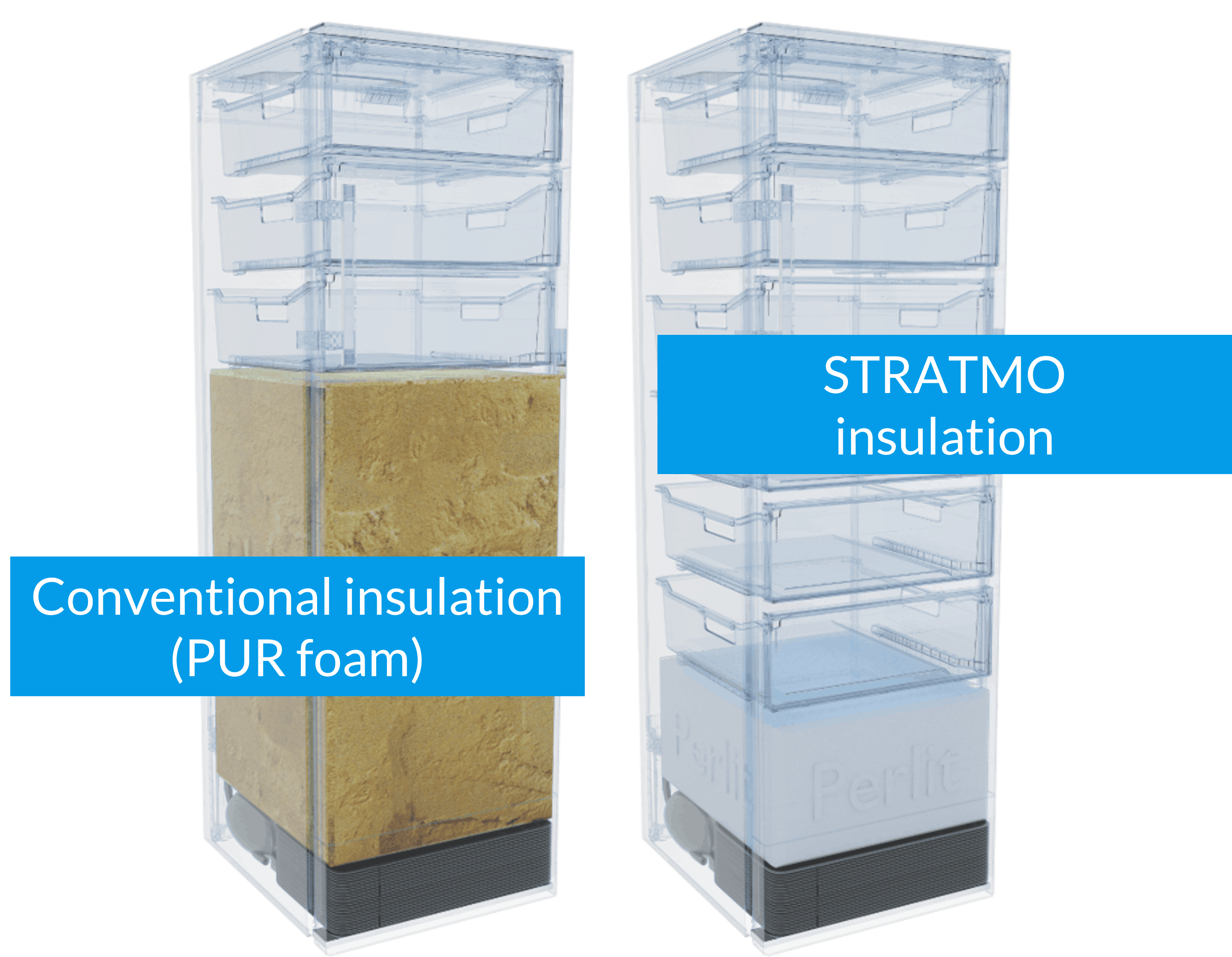
With fixed external dimensions, every millimetre occupied by the wall is a millimetre unavailable inside. With foam insulation, achieving better thermal performance largely means increasing thickness. A thicker wall may improve the energy efficiency class, but it reduces internal space. A thinner wall creates more space, but compromises insulation performance.
The calculation is straightforward, yet its impact is often underestimated. Each dimension has two opposing walls. Increasing the insulation thickness by 10 millimetres per wall reduces the internal dimension by 20 millimetres. The same principle applies to height and depth, so the effect on volume is multiplicative. Just a few millimetres can translate into a double-digit percentage gain in usable volume. An internal space measuring 50 × 50 × 50 centimetres becomes 54 × 54 × 54 centimetres when insulation is reduced by 20 millimetres per wall — an increase of around 25 per cent in volume.
This trade-off helps explain why improvements between product generations have often been incremental. External requirements add to the pressure: energy efficiency standards continue to rise, and efficiency ratings influence how products are presented in retail. With conventional foam, improving insulation performance generally requires more thickness. Eventually, there is simply no room left.
What changes with vacuum insulation?
With vacuum insulation, thermal performance is no longer tied to wall thickness in the same way as with conventional foam. Evacuating the pores of the core material greatly reduces heat transfer through the gas they would otherwise contain. The evacuated perlite used as the core material in STRATMO achieves a thermal conductivity of around 7 mW/(m·K) at 10 °C. At normal atmospheric pressure, the same material used as loose fill provides substantially poorer insulation. Compared with PUR foam, this makes it possible to achieve equivalent insulation performance with a fraction of the wall thickness. We explain how the core, envelope and vacuum work together in our article on how film-based perlite vacuum insulation works.
For your product, this means wall thickness is no longer a fixed constraint. It becomes a design decision.
How can you use the space you gain?
There are three objectives to weigh against each other — and choosing between them is a product design decision, not merely a technical one. You can increase usable volume without changing external dimensions, improve the energy efficiency class while maintaining the same internal volume, or reduce external dimensions without sacrificing capacity.
This decision belongs at the beginning of the design process, not at the end. If you only consider it after the design concept has been frozen, you may be limited to a straightforward material substitution — the option that offers the least additional value.
Which products benefit most?
Any product that needs to maintain a temperature difference within fixed external dimensions can benefit. The underlying calculation remains the same; only the design constraints change.
In refrigerators and freezers, the dimensions of the installation recess are fixed. Every centimetre saved in the walls can provide more usable volume or help achieve a better energy efficiency class. As these appliances also need to accommodate more and more internal features, pressure to reduce wall thickness is particularly high.
For hot-water and heat-pump storage tanks, available floor space and cellar doorways restrict external dimensions, while standby heat losses influence the energy efficiency class. Thinner insulation with equivalent thermal performance allows more storage capacity within the same space.
For district-heating pipes and other insulated pipelines, the entire route matters, not just an individual component. Slimmer insulation can mean narrower trenches and less excavation, or lower heat losses along the route with the same available cross-section. For a DN 125 district-heating pipe, this can result in an external diameter around 20 per cent smaller than with PU foam.
In compact cooling applications, such as drawers and transport boxes, installation space is limited from the outset. In our SILYNT product line, we combine vacuum insulation with thermoelectric cooling.
Why is simply replacing the material not enough?
Because it leaves much of the potential untapped. The most common mistake is a like-for-like substitution: remove the existing foam, install vacuum insulation and leave everything else unchanged. This can work, but it uses only one of the three possible approaches and misses the wider opportunities for redesign.
In one joint project, rather than simply retrofitting a freezer, we reconsidered its design. The thinner walls made it possible to rearrange the refrigeration system as an easily replaceable drawer. Usable volume, serviceability and energy efficiency all improved at the same time. The result was not merely a better-insulated appliance, but a fundamentally different product.
These effects extend to manufacturing. Because a vacuum insulation component can be produced in the required shape, including complex three-dimensional geometries, without joints between individual panels, spacers and parts of the supporting structure may no longer be needed. Eliminating these elements can also remove production steps. Insulation and structural support are created in a single component.
What are the limits of the technology?
The benefits are limited where installation space is not a concern or where the required insulation is already very thin. For STRATMO, the practical minimum insulation thickness is around 30 millimetres; for STRATMO+, around 10 millimetres. Below these values, the benefits rarely justify the effort.
A vacuum insulation component also cannot simply be cut to size during assembly. Its envelope must remain airtight, so penetrations, fixing points and edges need to be designed in from the outset rather than drilled or cut afterwards. Whether a particular geometry can be manufactured economically depends on the specific component, not just a data sheet.
Vacuum insulation components cannot be manufactured on a conventional foam production line either. However, this need not delay a product launch. During the launch phase, we manufacture the components ourselves, allowing you to begin series production before adapting your own manufacturing processes.
How to assess the potential for your product
- Identify the fixed external dimensions. Record which dimensions cannot change and why — whether due to an installation recess, a doorway, a pipeline corridor or transport requirements.
- Measure the current wall thickness. The further it exceeds the minimum insulation thickness, the greater the potential gain.
- Define your primary objective. Decide whether you want more usable volume, a better energy efficiency class or smaller external dimensions. Trying to maximise all three simultaneously is rarely the best solution.
- Look for additional design benefits. Consider where spacers, supporting structures or joints could be eliminated if the insulation component also provides structural support.
- Start with a pilot component. Focusing on one specific component rather than committing to a complete redesign keeps the initial effort manageable.
Frequently asked questions
Which applications is STRATMO suitable for?
STRATMO is suitable for products where available space or energy efficiency is a key constraint. Typical applications include refrigerators and freezers, hot-water and heat-pump storage tanks, district-heating pipes, and insulating panels and boards. STRATMO is the proven basis for series production in most of these applications.
How does STRATMO increase usable volume in refrigeration appliances?
It provides equivalent insulation performance with significantly thinner walls. When the installation recess is fixed, every millimetre saved in wall thickness creates additional internal space — twice along each dimension, because there are two opposing walls. Alternatively, the same advantage can be used to improve the energy efficiency class.
How much additional usable volume is possible?
That depends on the current wall thickness, the target energy efficiency class and the product geometry. A reliable figure can only be calculated for the specific product. As a general rule, the thicker the existing insulation, the greater the potential.
Do I need to redesign my entire product?
No. Replacing the insulation within an existing design is possible, provided that penetrations and fixing points are taken into account. This can already improve usable volume or efficiency. However, the greatest benefit generally comes from incorporating thinner walls into the design from the outset, so early involvement is important.
What is the difference between STRATMO and STRATMO+ in terms of space requirements?
Both are based on a self-supporting perlite-based vacuum insulation component. STRATMO+ is intended for applications with particularly demanding insulation requirements or very limited installation space, enabling the thinnest designs. STRATMO covers most other applications.
Conclusion
For a product with fixed external dimensions, the decisive factor is not the insulation material itself, but the space it occupies. Reclaiming that space creates three options where previously there was a trade-off. The real design challenge is deciding how to balance those options to achieve the greatest benefit for the product. Vacuum insulation. Rethought. Brought into series production.
If you would like to find out how much space your product could gain, get in touch with us. During an initial technical discussion, we will review the external dimensions, your target energy efficiency class and the greatest opportunities for your application. You are also welcome to visit us in Karlstadt and experience a vacuum insulation component first-hand. You can reach us at info@terravac.de.
You can find short answers to further questions in our STRATMO FAQs.